Cooking Classes for Date Night: Romantic Ideas in NJ
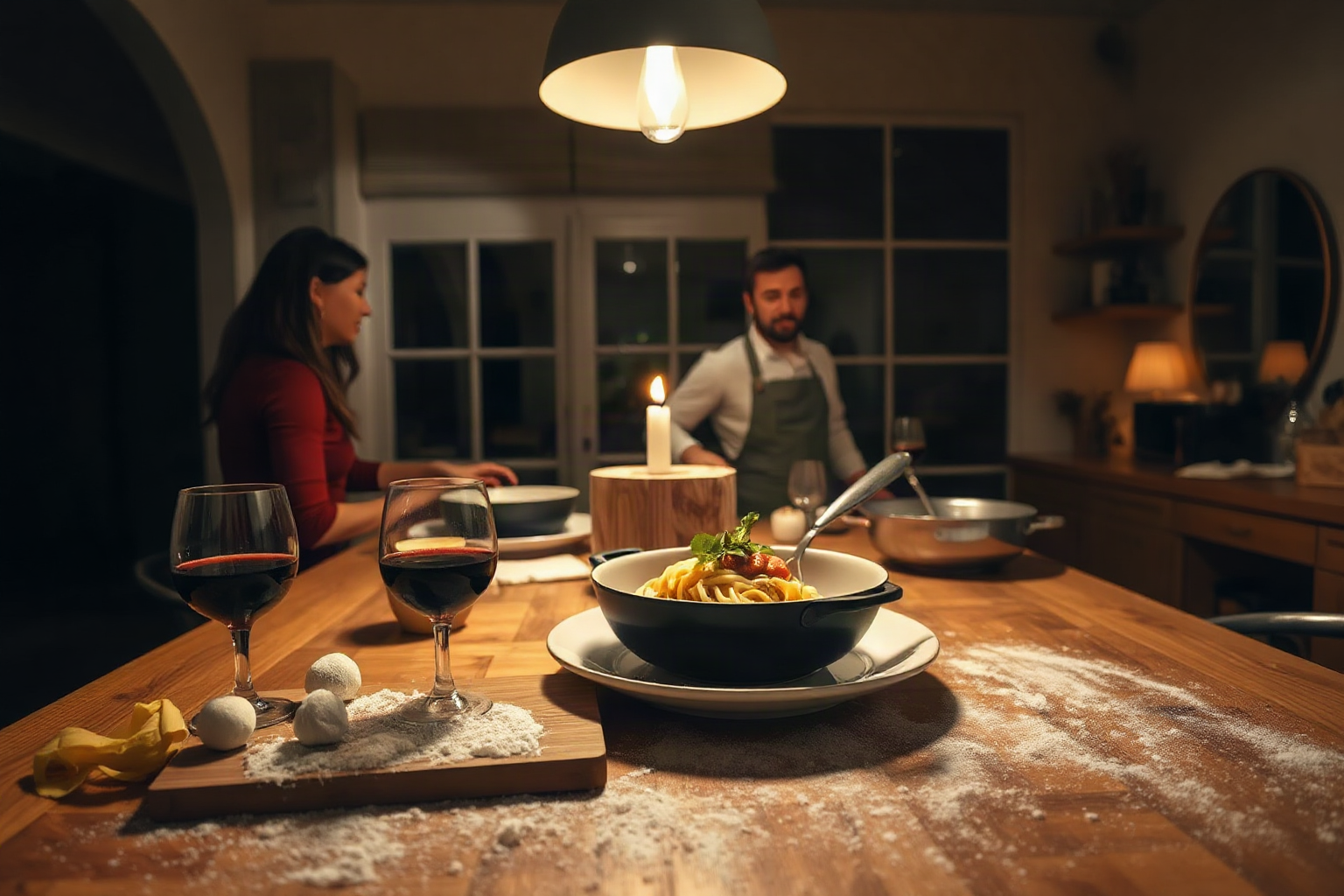
Somewhere between the fourth and fortieth dinner out, the ritual stops doing its job — you still enjoy the evening, but you could describe it in advance. A cooking class puts something unpredictable back in: two people, one chef, a shared counter, and a meal you build together and then sit down to eat. What follows is a practical look at how a date-night class actually runs when it happens in your own kitchen, how to choose a menu that fits the mood you're after, and what it costs before you commit.
Why Does a Cooking Class Beat Another Restaurant Reservation?
The restaurant default is hard to argue with until you've done it forty times. You book, you drive, you order, you eat, you leave. Nothing goes wrong, and nothing surprising happens either. That's the gap a cooking class fills. The evening has a task in it — a genuine, slightly awkward, hands-busy task — and that changes the way two people talk to each other. You're learning something together, you're mildly out of your comfort zone, and you're working side by side rather than across from each other. Couples tend to leave with a story, a dish they can repeat at home, and the private joke that comes from watching your partner attempt to fold a pasta sheet for the first time.
There's a quieter advantage too. A restaurant date asks you to perform a version of yourselves: dressed, on time, charming to a server. Cooking at home in an apron, with flour on the counter and a sauce that needs rescuing, is a far more honest evening — and honesty is what makes a night memorable rather than merely pleasant. Psychologists who study relationships talk about "shared novel experiences" as one of the more reliable ways couples refresh how they see each other. A class is that, with dinner attached.
For people searching "cooking classes NJ for fun," the appeal is usually the same: they want a night out that isn't passive. New Jersey makes this unusually easy because so much of it happens at home. No venue hunt, no circling for parking in a downtown that was never designed for it, no fixed seating time, no babysitter clock running past midnight. The drive is to your own front door — and when the night ends, nobody has to coordinate a ride home.
What Does the Night Actually Look Like in Your Own Kitchen?
I arrive with the ingredients, the equipment I need, and a menu we've agreed on beforehand. The first fifteen minutes are deliberately slow: a short walkthrough of what we're making, the order it happens in, and who's doing what. Then we cook. One of you might take the knife work, the other the pan. Some couples split by course; some cook every dish shoulder to shoulder. Both work, and neither is the "correct" version.
The pace is unhurried in a way restaurant kitchens never are. You're not cooking against a ticket printer, so there's time for the questions people actually want answered: why a sauce breaks and how to bring it back, why the fish goes in skin-side down and stays untouched, why seasoning early changes the whole result. That curiosity is usually the best part of the evening. Couples arrive expecting a performance and end up in a conversation about food.
A note on mismatched skill levels, because this worries more people than it should: it's normal, and it's fine. I've taught people who cook most nights and people who own one dull knife. The class is designed so nobody stands around watching — the less confident cook gets the tasks that build quickly and visibly, the more experienced one gets the fiddly work that rewards attention. By the main course, the gap usually isn't noticeable.
And then there's the ending. You sit down and eat what you built, at your own pace, with your own wine and no one hovering to turn the room. Afterwards I clean up. Most couples underestimate how much that contributes to the romance of the night — nobody wants the last hour of a date spent scrubbing a sheet pan. That detail is also the clearest difference between an in-home class and a group class at a recreational studio: no shared station, no strangers, no rushing so the next session can begin.
How Do You Build a Menu That Sets the Mood?
The menu is where most of the romance lives, and it should be chosen for the two of you rather than picked off a list of options. I plan menus in an arc: something small and bright to open, one anchor dish that carries the evening, and a dessert that feels like an ending rather than an obligation. My own leanings run toward sustainable seafood — seared scallops, a whole roasted fish, a shellfish course — because it feels celebratory, cooks quickly, and rewards attention in a way that keeps both cooks engaged.
New Jersey is genuinely good to cook in seasonally, which helps. Late-summer tomatoes and sweet corn, striped bass and blue crab in their windows, autumn shellfish — a menu built around what's actually good that week tastes better and gives the class a sense of place. In August, that might mean a chilled corn soup, a simply grilled fish, and peaches. In February, it's more likely fresh pasta with a slow-built ragù and something citrus-forward to finish.
I ask two questions early. First, what do you actually eat when nobody's watching? Second, is there anything either of you won't touch? A date-night class that quietly ignores one person's shellfish allergy isn't romantic, it's a long evening. Couples who train hard or eat to a plan — a nod to the performance nutrition work I do with athletes — can get a lighter menu that still reads as an occasion: bright citrus, good olive oil, grilled seafood, a dessert that doesn't undo the week.
Two short examples of how this plays out. A couple in Montclair wanted their tenth anniversary to feel like a restaurant without leaving the house; one of them had stopped eating meat a year earlier. We built the evening around a whole roasted fish for two, a charred vegetable course that carried equal weight, and a chocolate dessert neither had made before. Nobody ate a "substitute." The other was a double date in Hoboken — four people, one small kitchen — where the menu was deliberately hands-on: pasta, a shared seafood course, and a dessert assembled rather than baked. More people, more noise, more fun, and the host couple's kitchen never felt crowded because the work was sequenced rather than simultaneous.
What Does It Cost and How Do You Plan the Evening?
Let's be direct about pricing, because vague answers waste everyone's time. Private chef work across NJ, NY, and CT runs $75–200 per hour, and events are quoted between $400 and $2000 depending on guest count, menu, and how much of the cooking happens in front of you. A cooking class is priced the same way — by headcount and ingredients — and you'll get a straight number before you commit, not a surprise afterwards. For context on where a class sits against other options, weekly meal prep is $300–600.
What actually moves a class quote is less mysterious than it looks. Guest count matters, but ingredient cost moves faster than labour cost: four people add more shopping than they add hours. Protein choice matters more than most couples expect — scallops and a whole fish cost differently from chicken. Course count matters, and so does the day. A Tuesday in March is not priced like the Saturday before Valentine's Day.
A few planning notes. Book further out than you think you need to — two to three weeks is comfortable for a standard date night, and four to six weeks is realistic around holidays, anniversaries, and the warmer months. Decide in advance whether this is a surprise or a shared plan; surprises work best when the other person genuinely likes being surprised, and I'll coordinate quietly with the planning partner when they do. Consider making it a double date: four people cost a little more overall but usually less per person, and a fuller kitchen is a livelier one. And if the evening is a gift, tell me the recipient's tastes rather than your own — the menu should sound like their idea of a good night.
Looking ahead into 2026, the couples I cook for keep telling me the same thing: they'd rather have one memorable evening at home than three forgettable ones out. At-home experiences have stopped being the fallback and started being the plan.
Key Takeaways
- A date-night cooking class replaces the restaurant routine with something active, shared, and repeatable at home — and the shared task is what couples remember.
- The class happens in your kitchen, with ingredients and equipment brought to you: no venue, no parking, no fixed seating time, and cleanup handled at the end.
- Menus work best built in an arc around what you both genuinely like, with sustainable seafood, seasonal Jersey produce, and hands-on dishes like fresh pasta as strong anchors.
- Pricing follows headcount, ingredients, and course count, quoted the same way as private chef hours ($75–200/hour) and events ($400–2000) — ask for a firm number up front.
- Two to three weeks' notice covers most dates; four to six is sensible around holidays. Four guests turn it into a relaxed double date without much extra cost per person.
Frequently Asked Questions
Do we need any cooking experience to enjoy a date-night class?
No. Most couples who book are enthusiastic home cooks at best, and plenty are complete beginners. The class is structured so every task has a clear purpose, and I work alongside you rather than watching from a distance. Mismatched skill levels between partners are the norm, not a problem.
Can the menu accommodate dietary restrictions or preferences?
Yes, and it should be discussed when you book. Allergies, shellfish aversions, vegetarian preferences, and lighter training-friendly menus are all straightforward to plan around when the chef knows in advance. Tell me at the booking stage rather than on the night — a good menu can absorb almost anything, but not at the last minute.
How is this different from a group cooking class at a studio?
Privacy, pacing, and cleanup. There are no strangers at a shared station, no fixed session length, and no rush to clear the room for the next booking. The menu is built for the two of you rather than chosen from a set list, and the kitchen is yours for the evening.
How far ahead should we book, and does it work as a gift?
Two to three weeks is comfortable for a standard date night; four to six weeks is wiser around holidays, anniversaries, and summer weekends. It works well as a gift — I can plan the menu around the recipient's tastes, and the evening can be set up as a surprise with a coordinating partner. Get in touch with your preferred dates and I'll tell you honestly what's available.
What's included, and what do we need to have ready?
Ingredients, the equipment the menu requires, instruction, and cleanup. You need a usable kitchen, a surface to work on, and an appetite. If your kitchen is small or your equipment is limited, say so when booking — the menu can be designed around what you have rather than what you don't.